 EN

How Does a Rainproof Digital Water Timer Save Water and Time?
A garden hose left running for twenty minutes delivers roughly the same amount of water whether the lawn needs it or not. That single fact explains why irrigation timers moved from professional horticulture into ordinary back gardens. The device does not make watering more sophisticated — it removes the two variables homeowners are worst at managing: duration and repetition.
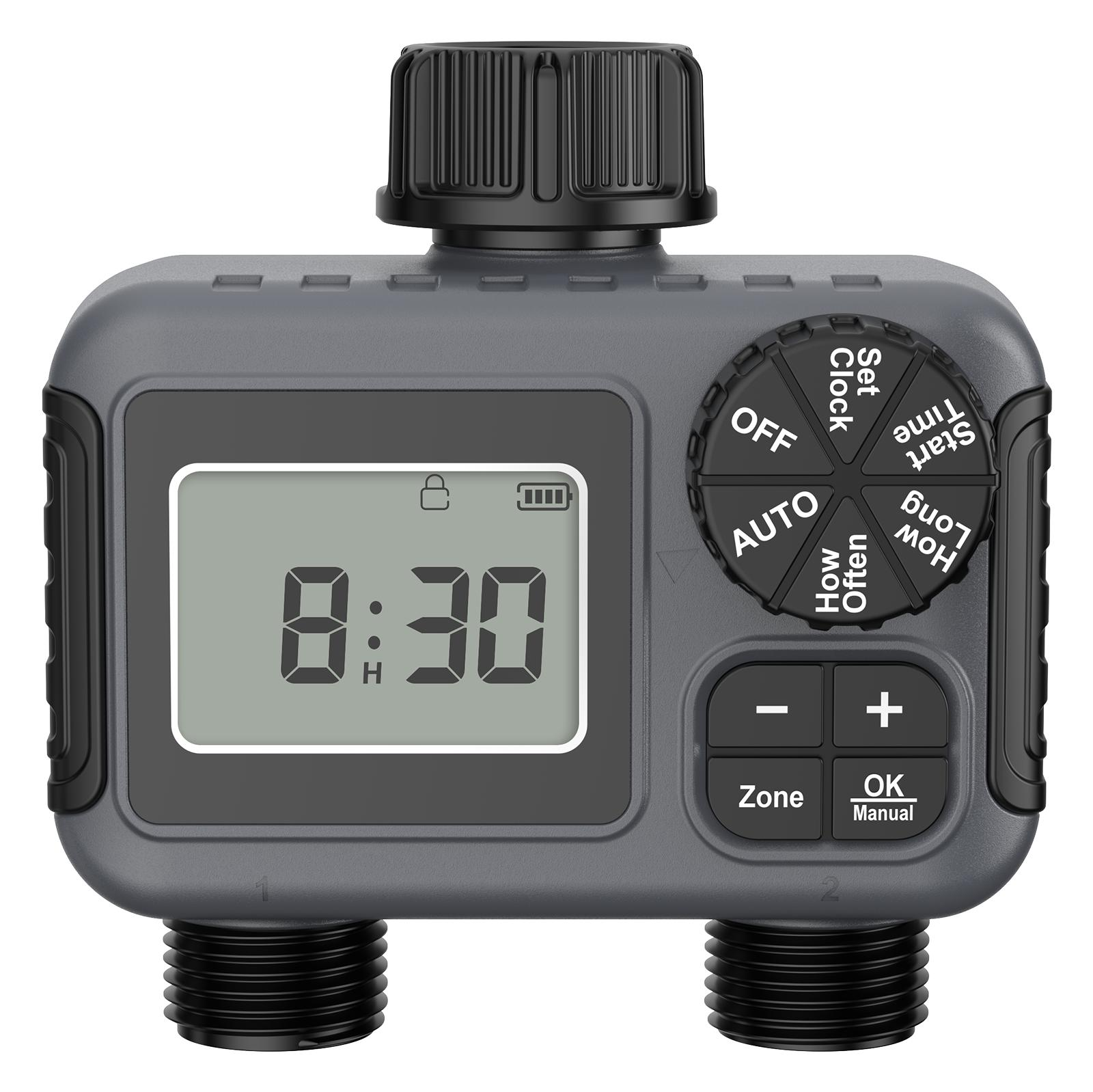
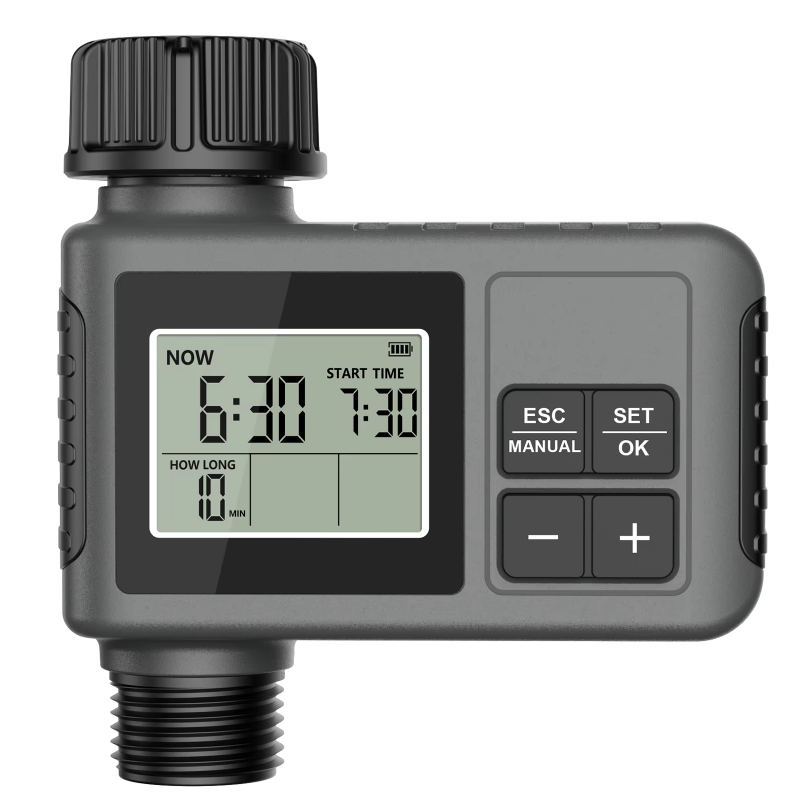
A rainproof single outlet digital water timer sits between the tap and the hose and takes over both. This article explains how these timers work, what the controls actually do in practice, and where the category's real engineering challenges lie.
Understanding What a Rainproof Digital Water Timer Does
The Three Settings That Matter
Almost every digital hose timer on the market is built around three programmable values: how often to water (the interval), how long each session runs (the duration), and when to start. The model covered here illustrates the practical range clearly — the watering interval can be set up to 15 days, each automatic session can run for up to 3 hours, and manual watering is available on demand for up to 120 minutes.
Those numbers reflect real use cases rather than arbitrary limits. A 15-day interval covers holiday watering for established beds and containers. A 3-hour maximum duration covers deep soaking for lawns and newly planted trees, where short shallow cycles encourage weak root systems. The 120-minute manual mode exists for the moments when someone is standing in the garden and simply wants water now.
Rain Delay Versus Rain Sensor
Buyers frequently confuse two different features. A rain delay is a scheduled pause: the user tells the timer to skip watering for a set number of days, and the timer resumes its programme afterwards. A rain sensor is an active input: a moisture-sensing device tells the timer that it is raining and the session is cancelled automatically.
This timer implements the first approach, with a 15-day rain delay function. That is a deliberate design choice, and for most domestic gardens it is the more reliable one. Rain sensors require mounting in an exposed position, suffer from debris and false triggers, and add a failure point that a purely scheduled device does not have. A rain delay requires the user to make a judgement once, then forgets about it.
For buyers specifying for commercial landscapes, the distinction is worth raising explicitly during product selection, since the two features are often marketed with similar language.
Why the Display and Lock Matter More Than They Sound
An LCD that shows the current programme, the next watering time, and the remaining battery is not a luxury. Timers are typically installed at ground level behind foliage, in poor light, and are checked infrequently. A clear display shortens every interaction.
The child lock addresses a specific and common failure. A timer mounted on an outdoor tap is within reach of children, and a single button press by a curious four-year-old can either cancel the schedule or flood the lawn. Mechanical locking or a button combination prevents accidental reprogramming — the kind of feature that is invisible in a specification sheet but decisive in a review.
Why Timing Beats Volume in Garden Irrigation
The Root-Zone Argument
Plants do not consume water on the day it is applied; they consume it over the following days as moisture migrates through the soil profile. A long, infrequent soak pushes water below the surface layer where evaporation is slow and roots are encouraged to grow downward. Short, frequent cycles keep moisture in the top few centimetres, which evaporates quickly and trains shallow roots.
This is why interval control matters more than flow rate. A timer that waters deeply every third day will generally produce healthier plants than one that waters lightly every morning, using the same total volume.
Water Waste Is a Scheduling Problem
Most domestic water waste is not caused by excessive flow. It is caused by watering at the wrong time of day, watering immediately before rain, and watering surfaces that are already saturated. A timer with a rain delay and a fixed early-morning start eliminates the first two categories at almost no cost.
The savings are difficult to quantify precisely because they depend on local climate and soil, but the mechanism is straightforward: scheduled early-morning watering reduces evaporation loss, and a rain delay removes redundant cycles after rainfall.
Practical Applications
Lawns and Established Borders
For lawns, the timer's value is consistency during heat waves, when hand watering tends to become either excessive or forgotten. A deep cycle every second or third day, run before sunrise, keeps turf out of drought stress without the runoff that occurs when dry soil is flooded quickly.
Containers, Raised Beds and Greenhouses
Containers dry out faster than open ground and benefit from shorter, more frequent cycles. A single outlet timer driving a drip line or soaker hose gives a small garden the same scheduling discipline as a commercial bed. In greenhouses, the timer removes one daily task from a routine that is otherwise full of them.
Holidays and Absences
The most common purchase trigger for this category is a two-week absence. A 15-day interval combined with a defined duration covers the trip without asking a neighbour to intervene. Users should test the programme for a week before departure rather than the night before, since tap pressure and hose length affect actual delivery.
OEM and Retail Programmes
Hose timers are a strong seasonal retail item, particularly in markets with large domestic gardens. Customisation typically covers housing colour, branding on the body and packaging, manual language, and unit conventions. Buyers should confirm the rainproof rating claimed for the housing, since "rainproof" is used loosely across the category and the actual ingress protection level should be stated explicitly on the specification sheet.
What to Check When Choosing a Water Timer
Ingress Protection and Housing Seals
Outdoor hardware fails at the seals. The battery compartment gasket, the display window bond, and the thread connection to the tap are the three locations where water enters. Buyers should ask for the specific IP rating and confirm that the battery door has a compressible gasket rather than a simple snap fit.
Thread Compatibility
Garden tap threads differ between regions, and a timer that fits one market may not fit another without an adapter. For export programmes, confirming thread standard and supplying the appropriate adapter in the box avoids a predictable category of returns.
Power and Battery Life
Battery life is a function of valve actuation and display usage. Solenoid valves draw a short burst of current at each cycle, so a programme with many short cycles drains faster than one with few long cycles. Buyers should ask for expected battery life at a stated watering frequency rather than an unqualified figure.
Valve Reliability
The solenoid valve is the only moving part and therefore the component that decides product lifetime. Buyers evaluating suppliers should ask about valve cycle testing and the materials used for the diaphragm, since cheap diaphragms harden and leak within a season or two.
Limitations and Realistic Expectations
A timer controls when water flows, not how much reaches the roots. Uneven ground, blocked emitters, and excessive hose runs will still produce uneven watering. Users should walk the line after installation and check that every outlet delivers.
Rain delays are manual judgements, not weather forecasts. A user who sets a three-day delay in a dry week has simply paused watering for no reason. The feature works best when combined with a quick glance at the forecast.
Finally, no timer survives a winter outdoors in freezing conditions. Units should be removed, drained, and stored before the first hard frost — a maintenance step that is rarely printed prominently enough in manuals and accounts for a significant share of spring failures.
FAQ
Can a water timer be left outside in the rain?
A rainproof timer is designed for outdoor installation and normal rainfall. That is not the same as being submersible or frost-proof. Units should be mounted above ground level where water cannot pool, and removed before freezing weather.
What is the difference between rain delay and a rain sensor?
Rain delay pauses the programme for a number of days chosen by the user. A rain sensor detects actual rainfall and cancels the session automatically. Rain delay is simpler and more reliable for domestic gardens; rain sensors suit installations where nobody is present to make the judgement.
How long can a timer water in one session?
On the model described here, an automatic session can run up to 3 hours, with manual watering available for up to 120 minutes. Longer durations suit deep soaking of lawns and trees; shorter cycles suit containers and raised beds.
Will a timer fit my outdoor tap?
Most units are supplied with a standard thread and an adapter for regional variations. Buyers in export programmes should confirm the thread standard for the destination market, since a missing adapter is one of the most common causes of avoidable returns in this category.