 EN

Ask a six-year-old to stop playing in five minutes and the answer is usually yes. Five minutes later, the same child is genuinely surprised that time is up. This is not defiance. It is a limitation of how young children perceive duration: time that cannot be seen is difficult to trust, and a warning that exists only as a sentence is easy to forget the moment attention moves elsewhere.
A visual timer for children addresses that limitation directly by turning duration into something with a shape. This article explains why the approach works, what the design details contribute, and where a mechanical visual timer stops being the right tool.
What a Visual Timer Actually Changes
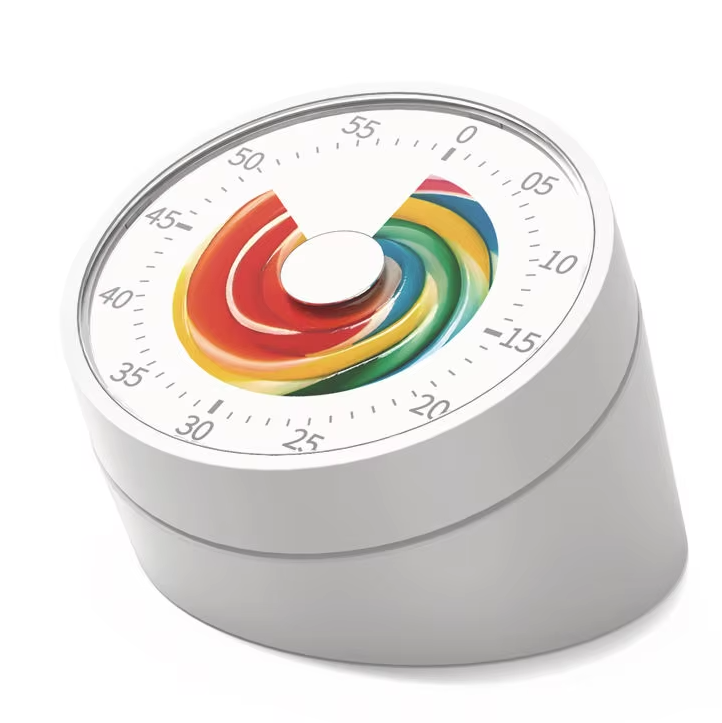
Making Duration Visible
A spoken warning describes time. A visual timer shows it. The difference matters because young children develop an understanding of duration slowly, and abstract units — minutes, quarter hours — carry little meaning until that understanding matures. A dial that visibly empties gives the child a reference they can check without asking an adult.
The model shown here takes a deliberately playful approach: a rotating rainbow dial that turns as the countdown proceeds. The visual change is continuous rather than a sudden alarm, which means the child receives information throughout the interval rather than only at the end.
Transferring the Authority
There is a second, less obvious benefit. When an adult announces the end of an activity, the adult becomes the source of the limit, and resistance attaches to the person. When a timer announces it, the limit belongs to the object. Many teachers and parents report that this shift alone reduces argument, because there is nothing to negotiate with a dial.
This is why visual timers appear so often in classrooms and in therapeutic settings where reducing conflict around transitions is a priority.
Supporting Transitions Rather Than Punishing Them
A timer used well is a warning system, not a sanction. The child sees the remaining time, finishes the current thought, and moves on. Used badly — started without explanation, or extended arbitrarily — it becomes noise. The tool is only as effective as the routine around it.
What the Design Details Contribute
A 60-Minute Range
A 60-minute timer covers the practical blocks of a school day: a lesson segment, a reading period, a homework session, a meal. That range is wide enough to be useful across ages and narrow enough that the dial remains readable. Timers that run to several hours turn the visible movement into something too slow to register.
The Rotating Dial
The rainbow rotating design is not decoration. Colour and rotation give the child two independent cues — position and colour change — which makes the remaining time legible from across a room. In a classroom, that matters: a teacher can see at a glance how much time a group has left without walking over.
Single-Button Operation
Simple button control matters more than specification sheets suggest. A device that requires a mode sequence will be set incorrectly, and a timer set incorrectly teaches children to distrust it. One button, one twist, done.
No Screen, No App, No Account
A mechanical visual timer has no firmware to update and no pairing process to fail. In classrooms, that reliability is the whole point. It also means the device does not compete with the screens it is often used to limit, which is a practical advantage rather than a philosophical one.
The Award as a Retail Asset
This model carries a Red Dot design award, which is a genuine differentiator on a retail shelf or a listing image. Buyers planning to use the award in marketing should confirm the scope of the award, the exact product it covers, and the licensing terms for referencing it in packaging and advertising — award marks are protected and usage conditions vary.
Practical Applications
Classrooms and Group Settings
Teachers use visual timers to structure independent work, timed reading, and clean-up transitions. The advantage in a group setting is that one device serves everyone: no repeated announcements, no individual negotiations. A 60-minute range allows a full activity block on a single setting.
Home Routines and Screen Time
At home, the same logic applies to homework, bath time, and screen limits. The timer is set once and placed where the child can see it. Parents who involve the child in setting the timer report better compliance, because the limit is agreed before the activity starts rather than imposed during it.
Therapy and Additional Needs
Visual timers are widely used in speech and language therapy, occupational therapy, and support for children who find transitions difficult. In these contexts the timer functions as a communication aid: it externalises a concept that is otherwise invisible, and it does so without language, which helps where language comprehension is itself the challenge.
Kitchen and General Household Use
Outside child-focused settings, a 60-minute mechanical timer is simply a robust kitchen timer. It does not need a battery change mid-recipe, it can be operated with wet hands, and it survives being knocked off a counter more gracefully than a touchscreen device.
What Buyers Should Check Before Ordering
Materials and Child Safety
The housing is plastic, and the relevant question is which plastic and how it behaves under repeated handling. Buyers in markets with strict toy or childcare regulations should confirm the specific material grades, the applicable test reports, and whether the product falls under toy regulations or general household goods — the classification changes the testing burden substantially.
The Battery Compartment
The timer uses AAA batteries, which is convenient and universally available. The compartment should require a tool or a firm two-step action to open, since a coin cell or AAA within reach of small children is a hazard that buyers increasingly screen for.
Alarm Volume and Duration
A classroom timer must be audible across a room without being startling. Confirm the alarm volume and whether it repeats. For home use, a quieter setting is often preferable, and buyers serving both markets may need two variants.
OEM Scope
For private label programmes, the practical customisation points are dial colour and pattern, housing colour, retail packaging, and manual language. Because the dial graphics are the product's main visual identity, buyers should confirm whether new artwork requires new tooling and what that does to MOQ and lead time.
Limitations and Realistic Expectations
A mechanical visual timer is not a precision instrument. It is designed to show a block of time, not to measure to the second, and buyers should not position it as a laboratory or examination timer.
It is also not waterproof. Kitchen use near sinks and steam will shorten its life, and housings that are not sealed will admit moisture through the dial gap over time.
And it does not solve the underlying difficulty. A timer structures a transition; it does not teach a child to estimate duration unaided. The goal, in most educational frameworks, is to use the visible timer as scaffolding and gradually withdraw it as the child's sense of time develops.
FAQ
At what age can a child use a visual timer?
Children as young as three can follow a coloured dial that visibly empties, although the concept of a specific number of minutes develops later. The device works best when an adult introduces it alongside the activity, so the child associates the dial's movement with what is happening.
Is a 60-minute timer too long for young children?
Not necessarily. A 60-minute range is a maximum, not a requirement. Short settings are used for most activities; the wider range simply allows the same device to cover longer blocks as the child grows or as classroom schedules demand.
How is this different from a phone timer?
A phone timer is abstract, requires unlocking a device, and introduces competing stimuli. A visual timer shows remaining time continuously, is always ready, and cannot be used to check messages. For children who are being asked to reduce screen use, that distinction is practical as well as symbolic.
Can the timer be private labelled?
Yes. Dial colour and pattern, housing colour, packaging, and manual language are the usual customisation points. Because the dial is the product's main visual element, new artwork may require new tooling — buyers should confirm MOQ and lead time implications before committing to a design.